
10 Laboratory Glassware Equipment Essentials for Setting Up a New Lab
A new lab rarely needs every piece of glass in a catalog on day one. It needs a short starter set that covers most practical work, bought in appropriate sizes and quantities. This guide covers ten pieces of laboratory glassware equipment that a new school, college or university lab should have before its first practical. For each one, you will find what it does, the common variants, and what to state in a first order.
Most of these items are made from borosilicate glass. It handles heat and most chemicals far better than ordinary soda-lime glass. That is why it is the usual choice for laboratory glassware equipment that goes on a hot plate or over a flame. Once the starter set is in place, a lab can grow into the fuller range it needs.
Why Borosilicate Glass Comes First
Borosilicate 3.3 glass takes its name from its low coefficient of expansion, about 3.3 × 10⁻⁶ per kelvin. The international standard ISO 3585 sets out the properties this glass should have. In practice, low expansion means the glass is less likely to crack when it is heated or cooled quickly.
- It tolerates heating on hot plates, burners and in drying ovens.
- It resists water, acids and most solvents. Hot strong alkalis and hydrofluoric acid still attack it.
- It does not rust or corrode the way metal does.
- It stays clear, so you can watch a reaction as it happens.
Borosilicate glass is not unbreakable: a dropped beaker still breaks, and a scratched flask can fail under heat. Buy it for its thermal and chemical resistance, not for impact strength.
The 10 Starter Items
The items below follow the order in which most departments use them, from general handling to more specialised apparatus.
1. Beakers

Beakers hold, mix and heat liquids. The low form, with a spout, is the everyday type, and the tall form suits work where splashing is a risk. Sizes run from small beakers of a few millilitres up to several litres.
The printed lines on a beaker are approximate. Use them to estimate volume, not to measure it. Our beakers category lists the forms we currently carry.
2. Test Tubes
Test tubes hold small samples for quick reactions, colour tests and gentle heating, and both rimless and rimmed styles are common. Boiling tubes are a wider, thicker version meant for direct heating.
Test tubes see the most breakage in a teaching lab, so give them a generous quantity in a first order. Racks and holders belong on the same order.
3. Pipettes
Pipettes move a measured volume of liquid from one vessel to another. A graduated pipette has a scale along its length and can deliver a range of volumes. A volumetric, or bulb, pipette has a single mark and delivers one fixed volume with better accuracy.
For measuring work, ask whether the pipette is Class A or Class B, since Class A has tighter tolerances and costs more.
4. Flasks

Flasks come in several shapes, and each shape has a job.
- Conical (Erlenmeyer) flask: the narrow neck lets you swirl liquid without spilling. It is the standard vessel for titration.
- Volumetric flask: one mark on the neck, used to make up a solution to an exact volume.
- Round-bottom flask: heats evenly and is used for boiling, distillation and reflux.
- Flat-bottom flask: stands on the bench and suits general heating and storage.
Measuring cylinders are not flasks, but they sit beside them on most lists. Use them when a beaker is too rough and a volumetric flask is too exact. Browse our flasks category for the shapes in the catalog.
5. Glass Bottles
Reagent bottles store chemicals and made-up solutions. Narrow-mouth bottles suit liquids, wide-mouth bottles suit solids, and amber glass protects light-sensitive reagents.
Other bottles on a typical list include dropping bottles, wash bottles and weighing bottles. See the glass bottle range for the types listed.
6. Petri Dishes

A petri dish is a shallow dish with a loose lid. Biology labs use it to grow bacteria and fungi on agar. Glass dishes can be sterilised and reused, while plastic dishes are sold sterile and are used once.
7. Stirring Rods
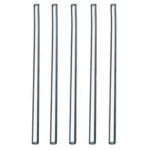
A glass rod stirs solutions, guides liquid down into a funnel and breaks up solids. It is the cheapest item in a starter set, yet new labs often run short. Fire-polished ends are worth asking for, because sharp ends scratch glassware.
8. Condensers
A condenser cools vapour back into liquid. Cold water flows through an outer jacket while vapour passes through the inner tube. A Liebig condenser has a straight inner tube and suits simple distillation. Allihn (bulb) and coil condensers give more cooling surface and are common for reflux.
Check that the condenser joints match your flasks before you order. Our condensers category lists the Liebig, Allihn, coil and double-surface types.
9. Centrifuge Tubes
Centrifuge tubes hold samples while a centrifuge spins them. The spinning pushes heavier particles to the bottom, which separates solids from liquid. Conical-bottom tubes collect a compact pellet, while round-bottom tubes are easier to clean.
Tubes are made in glass or plastic. Whatever you choose, match the tube to the speed rating of your centrifuge and to its rotor. The centrifuge tubes category shows the glass tubes we list.
10. Standard Joints
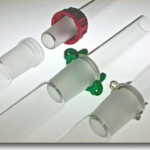
Standard ground-glass joints let you connect flasks, condensers and adapters without rubber bungs. A tapered cone fits into a matching socket. Sizes are given as two numbers, such as 14/23, 19/26, 24/29 or 29/32. The first is the wide diameter in millimetres and the second is the ground length.
Plastic or metal joint clips hold the parts together. Buy every joint in one set to the same size series, or buy adapters to bridge different sizes.
Specifying Laboratory Glassware Equipment for a First Order
A starter order of laboratory glassware equipment is only useful once each line has a size and a quantity. This table shows what to state for each item.
| Item | What to state in the order |
|---|---|
| Beakers | Capacity, low or tall form, glass type |
| Test tubes | Diameter and length, rim style, quantity per pack |
| Pipettes | Graduated or volumetric, volume, Class A or B |
| Flasks | Shape, capacity, neck type or joint size |
| Glass bottles | Capacity, narrow or wide mouth, clear or amber, cap type |
| Petri dishes | Diameter, glass or plastic |
| Stirring rods | Length, diameter, fire-polished ends |
| Condensers | Type, jacket length, joint sizes |
| Centrifuge tubes | Capacity, bottom shape, glass or plastic, speed rating |
| Standard joints | Joint size, cone or socket, clips needed |
Care, Safety and Delivery Checks
Inspect all laboratory glassware equipment before each use. Take chipped, cracked or starred pieces out of service, and never heat a flask that has a scratch or a star crack.
Wash glassware soon after use, and use brushes made for the item. Follow your institution's safety officer and the maker's instructions for heating limits and cleaning agents.
When an export shipment arrives, count each carton against the packing list before you sign for it. Check glass items for cracks and chips, and photograph any damage. Report problems to the supplier quickly, quoting the invoice number.
Growing Beyond the Starter Set
These ten items are the minimum starter set of laboratory glassware equipment for a teaching lab. As the lab grows, it will add burettes, funnels, desiccators and more adapters. For that fuller inventory, see our list of 25 glassware items, or browse the full laboratory glassware category.
Prices are quoted on request, based on quantity, specification and delivery country. To get a quote, send your list with sizes and quantities through our quote request page. Add your tender reference if the order is for a public tender.