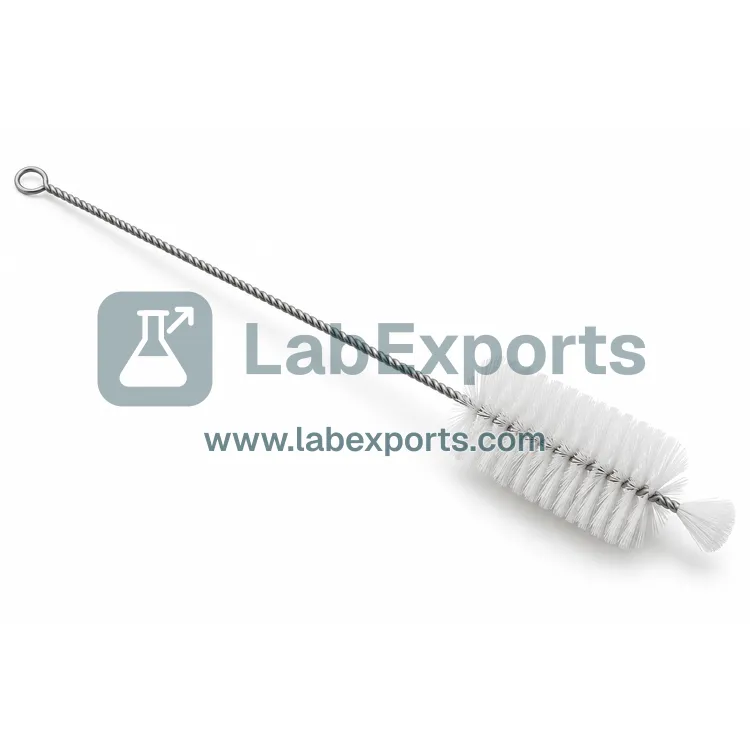
Beaker Brush
Beaker Brush: hard nylon bristles on twisted G.I. wire, head 140 x 63 mm, overall length 400 mm.
Equipping a new lab or bidding on a tender? Our sales team quotes volume orders directly.
Government & Tender Supply
is used to exchange the ions; the transfer of ions occurs between two electrolytes or between an electrolyte solution and a complex.
Water Softening Theory The usual ion exchange material employed in water softening is a sulphonated styrene-based resin, supplied in the sodium form. This has a strong affinity for calcium and magnesium ions and will also remove ferrous ions after the almost complete removal of calcium and magnesium. Softening may be carried out as a batch process by stirring a suspension of resin in the water until equilibrium or an acceptable level of hardness is reached. It is more convenient to operate as a continuous flow process, passing the water slowly downwards through a column of resin beads. The exchange reaction takes place rapidly enough for the upper layers of the bed to approach exhaustion before the lower layers are able to exchange ions. Thus there is a zone of active exchange which moves down the column until the resin at all depths becomes exhausted. The position at an intermediate stage is illustrated.
When the zone of active exchange reaches the bottom of the column the emerging water begins to show an increasing hardness. This is the breakthrough point when it becomes necessary to regenerate the resin with a strong sodium chloride solution.
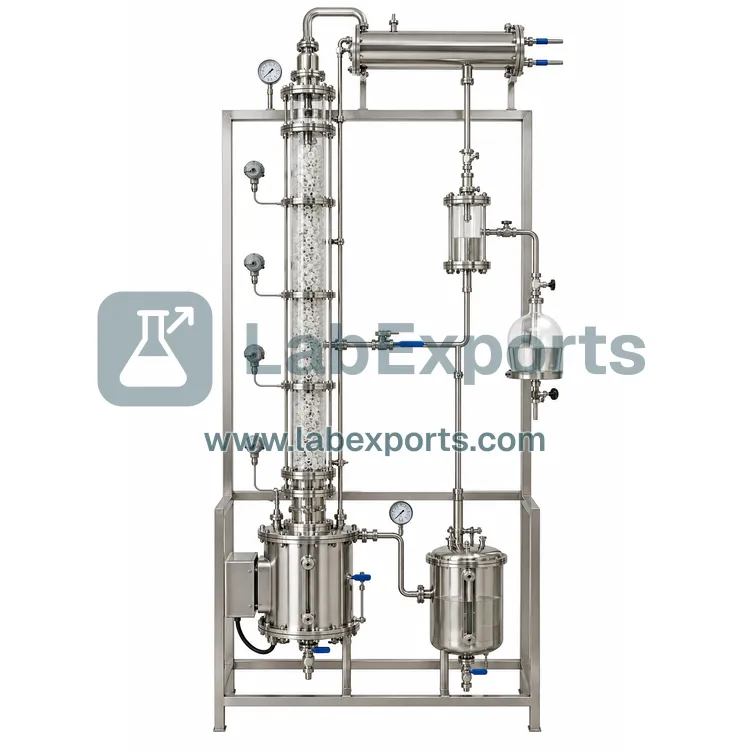
Technical Details Pump: Self priming diaphragm type Flowmeter range: 10-80ml/min Sump tank capacity: 20 litres Anion exchange resin: 0.75 litre Cation exchange resin: 1litre Chemicals required (not supplied): Sodium chloride Hydrochloric acid Sodium hydroxide Ordering Specification Self-contained apparatus either for single bed water softening or double bed system for demineralisation. Two vertical transparent tubes house the resins. A manifold at inlet/outlet allows flow configuration changes. Equipment includes pump, valves, conductivity meter and sumps for regenerant and test or wash solutions. Typical commercial cation and anion resins are supplied. Recommended Equipment Cartridge type water deioniser Replacement cartridges Beaker cell Services Required Electrical supply: 220-240V/1ph/50Hz 120V/1ph/60Hz| Product Line | Ion Exchange Unit |
|---|---|
| Discipline | Chemistry Lab Equipment |
| Manufacturing Standard | ISO 9001:2015 Quality Management System / CE Marking |
| Material Grade | Heavy-duty institutional grade, corrosion-resistant finish, laboratory safe |
| Export Packaging | Fumigated sea-worthy wooden crates with shock absorbent internal buffering (ISPM-15) |
| Inspection & Verification | Factory pre-dispatch inspection certificate included; third-party SGS / Bureau Veritas supported |
| Procurement Target | Universities, Technical Colleges, Secondary Schools, Research Institutes & Government Tenders |
We provide itemized technical compliance schedules, bid security documentation assistance, manufacturer authorizations (MAF), and warranty compliance letters for public tenders.
Export shipping arranged under FOB, CIF, or CFR terms via major Indian sea ports (Nhava Sheva / Mundra) and air cargo hubs. Full bill of lading and export customs clearance provided.
Click 'Request a Quote' or 'Add to Quote' on this page, specify your target quantity and delivery country, or email info@labexports.com. Our export team responds within 24 business hours with an official Proforma Invoice.
Yes. We provide complete technical compliance sheets, Bill of Quantities (BoQ) support, ISO 9001:2015 certificates, and manufacturer authorization letters (MAF) for government, university, and Ministry of Education procurement tenders.
Every item is packed in export-grade, fumigated, multi-ply sea/air-worthy wooden cases with shock-absorbing foam lining and waterproof barriers adhering to international ISPM-15 phytosanitary standards.
Yes. We routinely facilitate pre-shipment quality and quantity inspections by SGS, Bureau Veritas, Intertek, or any nominated third-party inspection agency before dispatch.