
Essential Science Lab Equipment for Schools: What to Buy First
A new school lab does not need everything at once. It needs a small set of items that support most practicals in physics, chemistry and biology. This guide covers the essential science lab equipment for schools: what each item does, and the one spec detail worth checking before you buy. Use it to plan a first order, or to fill gaps in a lab you already run.
Why start with essential science lab equipment for schools
Many practicals share the same basic apparatus: a beaker, a heat source and a thermometer together support dozens of lessons across all three sciences. Buying the essential science lab equipment for schools in sufficient quantities first means every group can work simultaneously, and specialist instruments can follow once the core is in place.
The core list
Beakers
Beakers hold, mix and heat liquids, and their flat base, straight sides and pouring lip make them the most versatile vessel in any laboratory. Schools usually stock several sizes, typically from 50 ml to 600 ml. Check: for heating, choose borosilicate 3.3 glass, the type set out in ISO 3585. It copes with heat far better than ordinary glass.

Conical flasks
A conical flask, also called an Erlenmeyer flask, has a flat base, sloping sides and a narrow neck. The shape lets students swirl a liquid without spilling it, which is why it is used in titrations. Check: the neck size, if you will fit stoppers or bungs.
Measuring cylinders and volumetric glassware
Measuring cylinders measure volumes for general work. Volumetric flasks and burettes measure more exactly, for making solutions and for titrations. Check: the class and tolerance marked on volumetric items.
Pipettes
A pipette moves a set volume of liquid from one vessel to another. Schools use glass volumetric pipettes with a pipette filler, and sometimes adjustable micropipettes for small volumes in biology. Never pipette by mouth. Check: that a safety filler is supplied with glass pipettes.

Weighing bottles
A weighing bottle is a small glass vessel with a ground-glass lid. It holds a solid while it is weighed and keeps out moisture from the air. Check: that the lid fits well; a loose lid defeats the purpose.
Balance
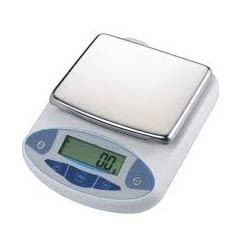
An electronic balance displays the mass of a sample quickly and unambiguously, which makes it easier for younger students to read than a traditional beam balance. Check: the capacity and readability. A balance that reads to 0.01 g suits most school chemistry.
Heat sources: Bunsen burner and hot plate
A Bunsen burner mixes gas with air to give a hot, clean flame. Opening the air hole gives a blue flame for heating; closing it gives a yellow safety flame. A hot plate heats without a flame, and a hot plate with a magnetic stirrer can heat and stir at once. Check: the gas type for burners (natural gas or LPG), and the voltage and plug for hot plates.
Thermometers
Thermometers appear in chemistry, physics and biology practicals alike, so they belong on every starter list. Check: the range; a 0 to 110 °C range suits most school work.
Microscope
A microscope lets students observe cells and microorganisms invisible to the naked eye. A school compound microscope with 4x, 10x and 40x objectives covers most biology practicals. Check: the light source. An LED lamp is bright and runs cool; a mirror works where power is unreliable.
Test tubes, racks and supports
Test tubes are used for small-scale reactions and qualitative tests, so schools consume them in large numbers. Each group also needs a test tube rack, a holder, and a retort stand with boss heads and clamps to support burettes and condensers. A tripod with wire gauze supports beakers over a burner. Check: that clamp jaws are lined, so they grip glassware without cracking it.
Physics basics
For physics, start with apparatus to measure forces and motion: spring balances, masses, a metre rule and a stopwatch. Add simple circuits with cells, bulbs, an ammeter and a voltmeter. Check: that meters have a range to suit student circuits.
Safety items
Safety goggles for every student, lab coats or aprons, a fire blanket and an eyewash point are part of the essential list, not extras. Your school's safety officer should set the rules for their use.
Storage and care
Essential items only stay useful if they are stored properly. Keep glassware in closed cupboards, sorted by type and size, so breakage is easy to spot. Store microscopes under dust covers, with the lowest-power objective in place. Record balances, thermometers and meters in an inventory, and check their readings against a known reference each term.
How many of each to buy
Quantity matters as much as the item list when you plan essential science lab equipment for schools. Count your largest practical class and divide by the planned group size to find the number of working sets you need. Then add spares for items that break or wear, such as beakers, test tubes and thermometers. Glassware breaks most, so it needs the biggest margin.
Where to go next
Once the core is in place, our guide to what lab equipment a high school science lab needs covers the fuller list. For the glass itself, see our laboratory glassware equipment list.
You can browse laboratory glassware, balance scales and student microscopes in our catalog. LabExports manufactures and exports this apparatus from India. Prices are on request, based on quantity, spec and delivery country. Send your list through the quote request page.